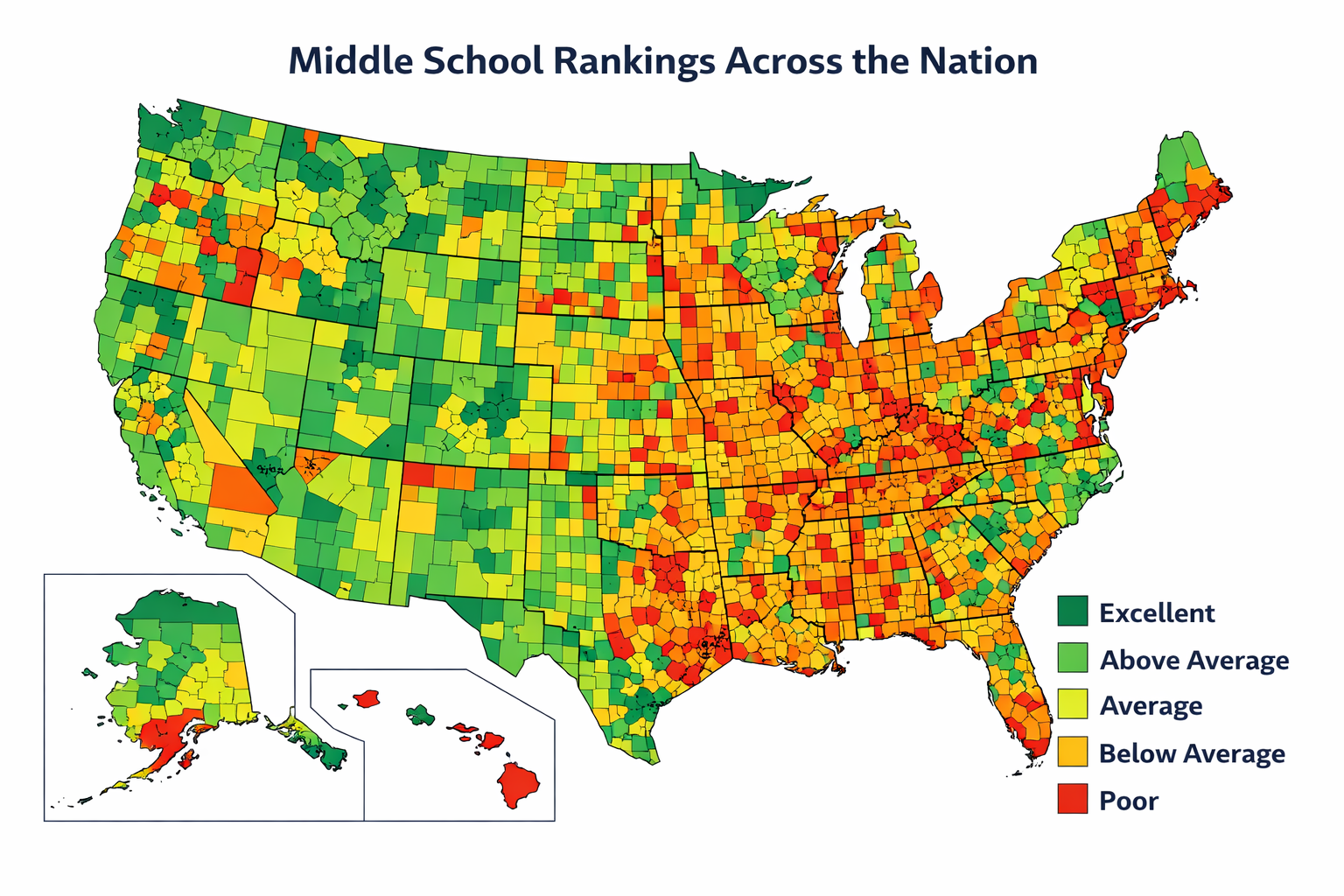
Understanding what the numbers mean — and what they leave out — during the most pivotal years of a student’s education.
Middle school is widely considered the most consequential transition in a student’s academic life. It’s where study habits solidify, social identity takes shape, and the academic trajectory toward high school and college begins to crystallize. Yet for decades, middle schools existed in a ranking blind spot — overshadowed by the college-pipeline prestige of high school rankings and the parental urgency of elementary school evaluations.
That’s changed. In the 2026 edition, U.S. News & World Report ranked over 23,000 public middle schools, while Niche evaluated 25,606 middle schools across the country, producing state, district, metro, and — in Niche’s case — national rankings. For the first time, families navigating the grades 5 through 8 landscape have data-driven tools comparable to what’s long been available for high schools.
| # | School Name | City | State | Grades | Niche Grade | Students | S/T* Ratio |
|---|
Who Ranks Middle Schools and How
U.S. News & World Report
U.S. News applies the same methodology to middle schools that it uses for elementary schools. Schools are evaluated on four equally weighted factors, each worth 25% of the overall score: math proficiency, math performance adjusted for socioeconomic context, reading proficiency, and reading performance adjusted for socioeconomic context. The data comes entirely from the U.S. Department of Education’s Common Core of Data, drawn from state assessment results.
The equity-adjusted components are particularly significant at the middle school level. Research consistently shows that achievement gaps widen during the middle grades, with socioeconomic disparities becoming more pronounced between 5th and 8th grade. By weighting half the formula on performance relative to expectations, U.S. News rewards schools that are closing those gaps — not just the ones with the wealthiest student bodies.
As with elementary schools, U.S. News does not produce a national middle school ranking. Schools are ranked only at the state and district levels, and charter schools receive separate state-level rankings. Student-teacher ratios serve as tiebreakers. Schools below the 25th percentile have their specific rank concealed, and private schools are excluded entirely.
Niche
Niche takes a broader approach, combining quantitative data with qualitative feedback from families and students. Its 2026 Best Public Middle Schools ranking factors include state test scores, student-teacher ratio, student diversity, teacher quality, middle school-specific ratings from parents and students, and the overall quality of the school district.
Each factor is standardized into a z-score and weighted based on statistical analysis and user preference research. The result is a composite score that produces both a letter grade (A+ through D-) and a numerical rank at the national, state, metro, and district levels. Niche ranked 25,606 public middle schools in its 2026 edition — meaning the top 100 represent the top 0.4% of all public middle schools in America.
Niche’s inclusion of parent and student reviews adds a dimension that pure test-score rankings miss. Middle school reviews frequently address topics like bullying climate, counselor availability, extracurricular breadth, and the quality of the transition support for incoming students — factors that matter enormously to families but don’t appear in any federal dataset.
What the 2026 Rankings Reveal
The Davidson Academy in Reno, Nevada — a small, highly selective school for gifted students affiliated with the University of Nevada — claimed the #1 spot on Niche’s 2026 Best Public Middle Schools list, with just 173 students and a 7:1 student-teacher ratio. It also earned the #1 Best Public Middle School designation from Davidson Academy’s own reporting of its Niche results.
Arizona’s BASIS charter network dominated the middle school rankings even more aggressively than at the elementary level. A total of 12 BASIS campuses placed in the national top 100, with 8 landing in the top 20. BASIS Scottsdale was named the #1 Best Public Middle School in Arizona and #4 nationally. The network’s academic model — which introduces a college-style subject-specialist approach in 5th grade and requires Advanced Placement coursework beginning in 8th grade — produces exceptionally high test scores, though critics note the model’s intensity contributes to attrition.
Florida, which dominated the elementary rankings, maintains a strong presence in middle schools as well. Schools like Pine View School in Osprey (which spans grades 2-12) and Rising Leaders Academy in Panama City continue to rank among the nation’s best.
Geographically, the top 100 middle schools span roughly 30 states, with the heaviest concentrations in Arizona, Florida, New York, New Jersey, California, and Texas. The Northeast and Midwest are well-represented by high-performing suburban districts — places like Syosset and Jericho on Long Island, Glenview and Winnetka in the Chicago suburbs, and Brookline outside Boston.
The Middle School Ranking Challenge
Ranking middle schools is inherently more difficult than ranking elementary or high schools, for several reasons.
State assessments vary more at the middle level. While most states test reading and math in grades 3 through 8, the content expectations, difficulty calibrations, and proficiency cut scores for grades 6-8 diverge significantly across states. A “proficient” 7th grader in Massachusetts is meeting a very different bar than a “proficient” 7th grader in Mississippi.
Growth matters more but is measured less. The middle school years are when students either accelerate or stagnate academically. A school that moves a struggling reader from a 3rd-grade level to a 6th-grade level in two years has accomplished something remarkable — but if that student still doesn’t meet the 7th-grade proficiency threshold, the school gets no ranking credit from U.S. News. Growth-based metrics, which some states report on their own school report cards, are not incorporated into either major national ranking system.
Non-academic factors carry outsized weight. Ask any middle school parent what they care about most, and test scores may not even make the top three. School safety, anti-bullying culture, mental health support, and the quality of advisory or homeroom systems often matter far more during these vulnerable years. None of these appear in the ranking formulas.
Course offerings diverge dramatically. By 7th and 8th grade, the availability of algebra, world languages, advanced science, and elective arts programs varies widely across schools. A middle school that offers Algebra I, Spanish, and orchestra in 7th grade is preparing students for a fundamentally different high school experience than one that doesn’t — but rankings don’t capture curricular breadth.
Charter Schools and the Rankings
Charter schools feature prominently in the middle school top 100. The BASIS network alone accounts for 12 of the top 100 spots nationally. Other charter networks with strong middle school showings include Success Academy in New York City, North Star Academy in Newark, and KIPP schools in various states.
This raises a recurring debate in education policy: do these schools rank highly because of superior instruction, or because of selective admissions, motivated families, and attrition of lower-performing students? The answer is almost certainly some combination of all four, and rankings alone cannot disentangle those factors.
For parents evaluating a charter middle school, the ranking is a starting point — but understanding the school’s admission process, retention rates, and whether it serves students with disabilities and English learners at rates comparable to the surrounding district tells a much more complete story.
How to Evaluate a Middle School Beyond the Rankings
Rankings capture academic output. They don’t capture what it feels like to be a 12-year-old walking through the front door. For families evaluating middle schools, a few additional dimensions deserve attention.
Transition support. How does the school onboard incoming 5th or 6th graders? Is there an orientation program, a buddy system, or a dedicated transition counselor? The quality of this process can define a student’s entire middle school experience.
Advisory or homeroom structure. Many of the highest-performing middle schools use advisory systems where a small group of students meets daily with the same adult throughout their middle school years. This provides a consistent relationship anchor during a period of rapid social and emotional change.
Course access and tracking. Does the school offer advanced math and world languages to all students, or only to those who test in? Research shows that broad access to rigorous coursework in middle school is one of the strongest predictors of high school and college success.
Climate data. Many states now publish school climate surveys that measure student perceptions of safety, belonging, and engagement. These are often more revealing than test scores when it comes to daily experience.
Extracurricular breadth. Middle school is when many students discover passions — in robotics, debate, theater, athletics, or community service — that define their identity going forward. A school with a rich extracurricular menu gives students more pathways to engagement, even if those offerings don’t show up in the rankings.
The Bottom Line
The expansion of middle school rankings to cover more than 25,000 schools is a genuine service to families. Having standardized, comparable data on schools that previously operated in an information vacuum makes the search process more transparent and less dependent on word-of-mouth.
But the numbers tell only part of the story. The best middle school for your child is the one where they feel safe enough to take risks, challenged enough to grow, and supported by adults who know them by name — and no ranking can measure that.
Sources: U.S. News & World Report 2026 Best Elementary and Middle Schools Rankings; Niche.com 2026 Best Public Middle Schools Rankings & Methodology; BASIS Charter Schools 2026 Niche Rankings Report; Davidson Academy 2026 Niche Recognition.