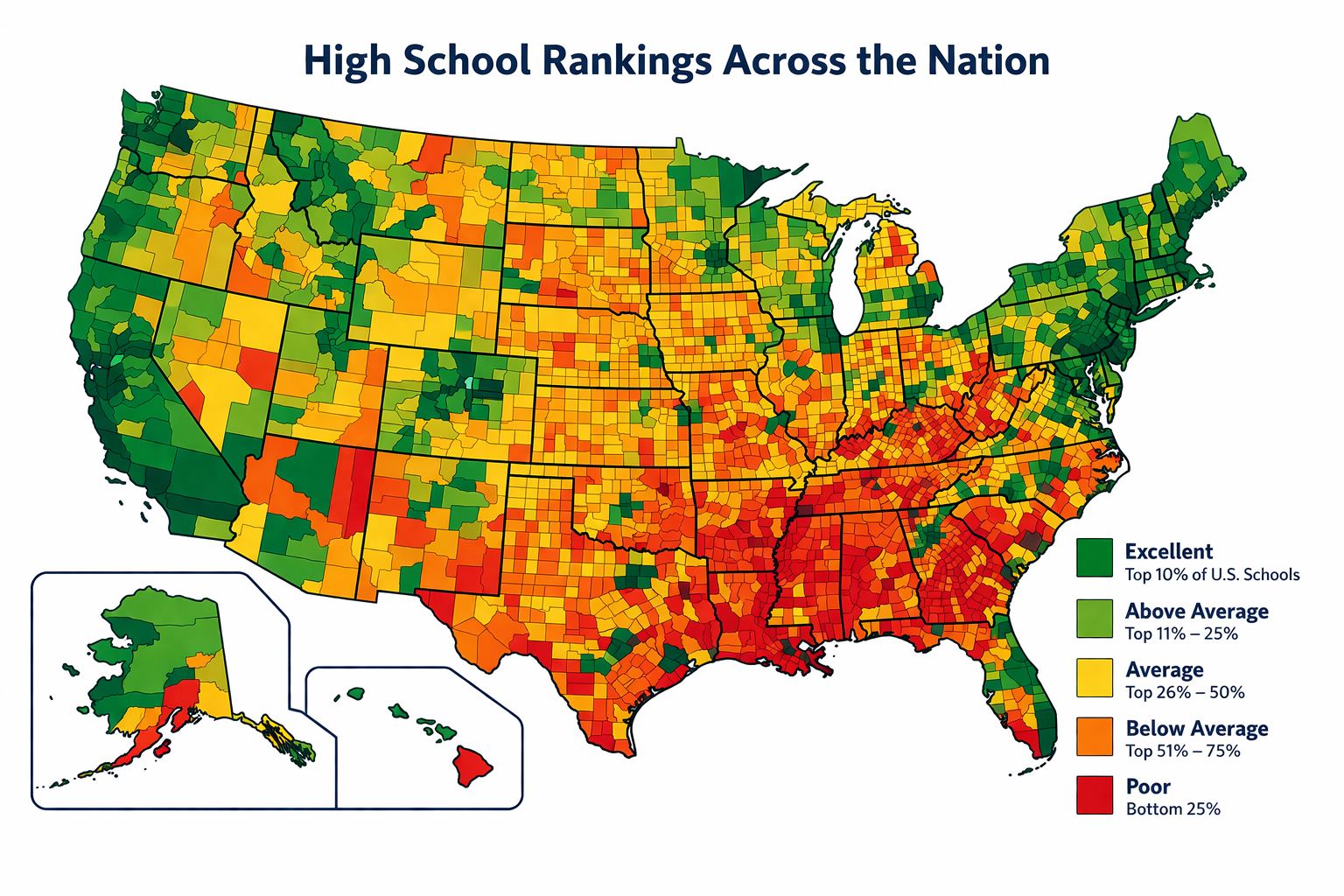
The highest-stakes school rankings in America — what drives them, where they agree, where they diverge, and what families should actually pay attention to.
High school rankings are the most watched, most debated, and most consequential school evaluations in America. They influence where families buy homes, which charter schools see surges in applications, and how communities perceive the quality of their public education systems. Unlike elementary and middle school rankings — which are relatively new and draw modest attention — high school rankings have been shaping public perception for over a decade, with real effects on property values, enrollment patterns, and school funding conversations.
In the 2025-2026 cycle, U.S. News & World Report evaluated more than 24,000 public high schools and ranked nearly 18,000 of them across all 50 states and the District of Columbia. Niche ranked 20,162 public high schools in its 2026 edition. Both ranking systems agree on many of the top schools, but their methodologies differ in ways that can move individual schools by dozens of positions — which is why understanding how the rankings work matters as much as knowing who tops them.
| # | School Name | City | State | Grades | Niche Grade | Students | S/T* Ratio |
|---|
U.S. News & World Report: The National Standard
U.S. News produces the most widely cited high school ranking in the country. Its methodology, developed in collaboration with RTI International (a global research institute), uses six indicators grouped into two broad categories.
College Readiness (30%) measures student participation and performance on Advanced Placement and International Baccalaureate exams. Schools where a higher percentage of students take AP/IB courses and earn qualifying scores receive higher marks. This single factor has an outsized influence on which schools appear at the top — virtually every school in the national top 25 has an AP participation rate above 80%, and many approach 100%.
College Curriculum Breadth (10%) evaluates whether schools offer a wide range of AP and IB subjects, rewarding institutions that provide access to advanced coursework across disciplines rather than concentrating on a few areas.
State Assessment Performance (20%) looks at student proficiency on state-mandated reading and math exams — similar to the elementary and middle school methodology.
State Assessment Performance Adjusted for Underserved Students (20%) examines how well the school educates students from historically underserved racial/ethnic groups and low-income backgrounds relative to state averages.
Graduation Rate (10%) measures the proportion of students who graduate within four years.
Graduation Rate Adjusted for Underserved Students (10%) evaluates whether underserved student populations graduate at comparable rates.
The U.S. News methodology is notably more complex than its K-8 approach. The addition of AP/IB data, graduation rates, and equity adjustments for underserved populations creates a formula that rewards schools doing three things well simultaneously: achieving high proficiency, preparing students for college-level work, and serving all students equitably.
One critical shift for the 2025-2026 edition: U.S. News continued to exclude SAT and ACT scores from its formula, reflecting the broader de-emphasis on standardized testing in college admissions nationwide.
Niche: The Community Voice
Niche’s 2026 Best Public High Schools ranking uses a broader set of inputs. Its stated factors include state test scores, college readiness, graduation rates, teacher quality, and high school ratings from students and parents. Notably, Niche also removed SAT/ACT scores from its formula this year.
What distinguishes Niche most is its incorporation of nearly three million reviews from students, parents, and teachers. These reviews address dimensions that no federal dataset captures: the quality of college counseling, the social climate, the rigor of specific departments, the availability of mental health support, and whether the school genuinely prepares students for life after graduation.
Niche produces both national and state-level rankings for public high schools, as well as specialized lists for STEM schools, schools for the arts, charter schools, and college prep schools. Each school receives a letter grade from A+ to D-, and the top 100 represent the top 0.5% of all public high schools in the country.
The 2025-2026 Top Schools
The two ranking systems largely converge at the very top:
BASIS Tucson North (Tucson, AZ) claimed the #1 spot on the U.S. News national ranking, jumping from #33 the previous year. The tuition-free charter school serves about 760 students in grades 5-12 with a curriculum that requires students to complete a capstone research project and extensive AP coursework. On Niche, BASIS schools collectively placed 7 campuses in the national top 100 for high schools.
The North Carolina School of Science and Mathematics (Durham, NC) — a residential public school for 11th and 12th graders — took the #1 position on Niche’s public high school list. Its 7:1 student-teacher ratio and exclusive focus on advanced STEM education consistently produce top rankings.
The Davidson Academy (Reno, NV) — the small gifted school that also tops the middle school rankings — earned #2 on Niche and #4 on U.S. News. With just 173 students and a 100% AP participation rate, it exemplifies the small, hyper-selective school model that dominates the top of both lists.
Other schools appearing in the top 10 on one or both lists include Signature School (Evansville, IN), Central Magnet School (Murfreesboro, TN), Thomas Jefferson High School for Science and Technology (Alexandria, VA), Albuquerque Institute of Math and Science (Albuquerque, NM), and the School for the Talented and Gifted (Dallas, TX).
Geographically, Arizona, California, Florida, and Texas each placed 11 schools in the U.S. News top 100 — the most of any states. New Jersey followed with 9. Massachusetts had the highest proportion of its total schools in the top quartile at 43%.
New York City’s specialized high schools — Stuyvesant, Bronx Science, Brooklyn Tech — remain strong but have slipped in national rankings relative to the charter school surge. Stuyvesant, once a perennial top-5 fixture, ranked #33 on U.S. News in the current cycle.
How High School Rankings Differ from K-8
High school rankings are fundamentally different from elementary and middle school rankings in several important ways.
College readiness dominates the formula. AP and IB participation and performance account for 40% of the U.S. News high school methodology — a factor that simply doesn’t exist in K-8 rankings. This means schools that aggressively expand AP access and push students into advanced coursework receive a massive ranking boost, regardless of how the broader student body performs on state tests.
There is a national ranking. Unlike elementary and middle schools, which U.S. News ranks only at state and district levels, high schools receive a national rank. This makes the list far more visible — and far more competitive — since schools are directly compared across state lines.
Graduation rates enter the picture. For the first time in the K-12 ranking progression, completion data matters. A school with stellar test scores but a 70% graduation rate will be penalized — an important equity check, since the highest-performing academic programs sometimes achieve their results partly through attrition.
Selectivity creates a distortion. Many of the top-ranked high schools use competitive admissions — entrance exams, auditions, GPA thresholds, or lottery systems with academic prerequisites. This means they are not serving a representative cross-section of their community’s students. A school that admits only the top 5% of applicants and then produces high test scores is demonstrating something real — but it’s not the same thing as a neighborhood school that educates every student who walks through the door.
The Charter School Question
Charter schools now dominate the top of national high school rankings more than at any other level. The BASIS network alone places multiple campuses in the top 25 nationally on both U.S. News and Niche. Other charter networks like KIPP, Success Academy, and Uncommon Schools also appear prominently.
The pattern is consistent: charter schools with rigorous academic models, extended school days, and cultures that emphasize AP completion tend to rank extremely well on systems that weight college readiness heavily. Whether this reflects superior instruction, self-selecting student populations, or some combination is one of the most contested questions in American education.
For families, the practical takeaway is that a charter school’s rank tells you about its academic output — but not necessarily about its accessibility, its support for students who struggle, or its retention rate. Asking about attrition between 9th and 12th grade, special education enrollment, and English learner services provides a more complete picture.
What Rankings Miss at the High School Level
Career and technical education. Schools with outstanding CTE programs — producing students who earn industry certifications, complete apprenticeships, or enter skilled trades — receive essentially no ranking credit. The formula is built around the college-prep pipeline.
Student mental health and wellbeing. The pressure-cooker environments at some top-ranked schools have been widely documented. Rankings do not account for student stress levels, mental health resource availability, or the social cost of relentless academic intensity.
Extracurricular depth. Debate teams, theater programs, athletic achievements, community service requirements, and student government — all of which shape the high school experience and develop skills that matter beyond test scores — are invisible in the rankings.
Post-graduation outcomes. Neither U.S. News nor Niche tracks what happens to students after they leave. A school that sends 95% of graduates to four-year colleges may look identical in the rankings to one where 60% of those students drop out before sophomore year. College enrollment is measured; college completion is not.
How to Use High School Rankings Wisely
For families, high school rankings are most useful as a filtering tool — a way to identify high-performing schools in a geographic area and begin the research process. They are least useful as a final verdict.
The right high school for a given student depends on that student’s academic interests, learning style, social needs, and post-graduation goals. A student passionate about engineering may thrive at a STEM magnet school ranked #15 nationally and struggle at a broadly excellent school ranked #3. A student who needs strong support services may find more success at a highly rated neighborhood school than at a hyper-competitive charter where the pace is relentless.
Visit the school. Talk to current students and parents. Look at the state school report card for data on climate, attendance, and discipline. Ask about counselor-to-student ratios, college advising, and what support exists for students who fall behind. These are the things that determine whether a school works for your child — and they don’t appear on any ranked list.
Sources: U.S. News & World Report 2025-2026 Best High Schools Rankings; RTI International 2025-2026 Best High Schools methodology; Niche.com 2026 Best Public High Schools Rankings & Methodology; BASIS Charter Schools 2026 Niche Rankings Report.