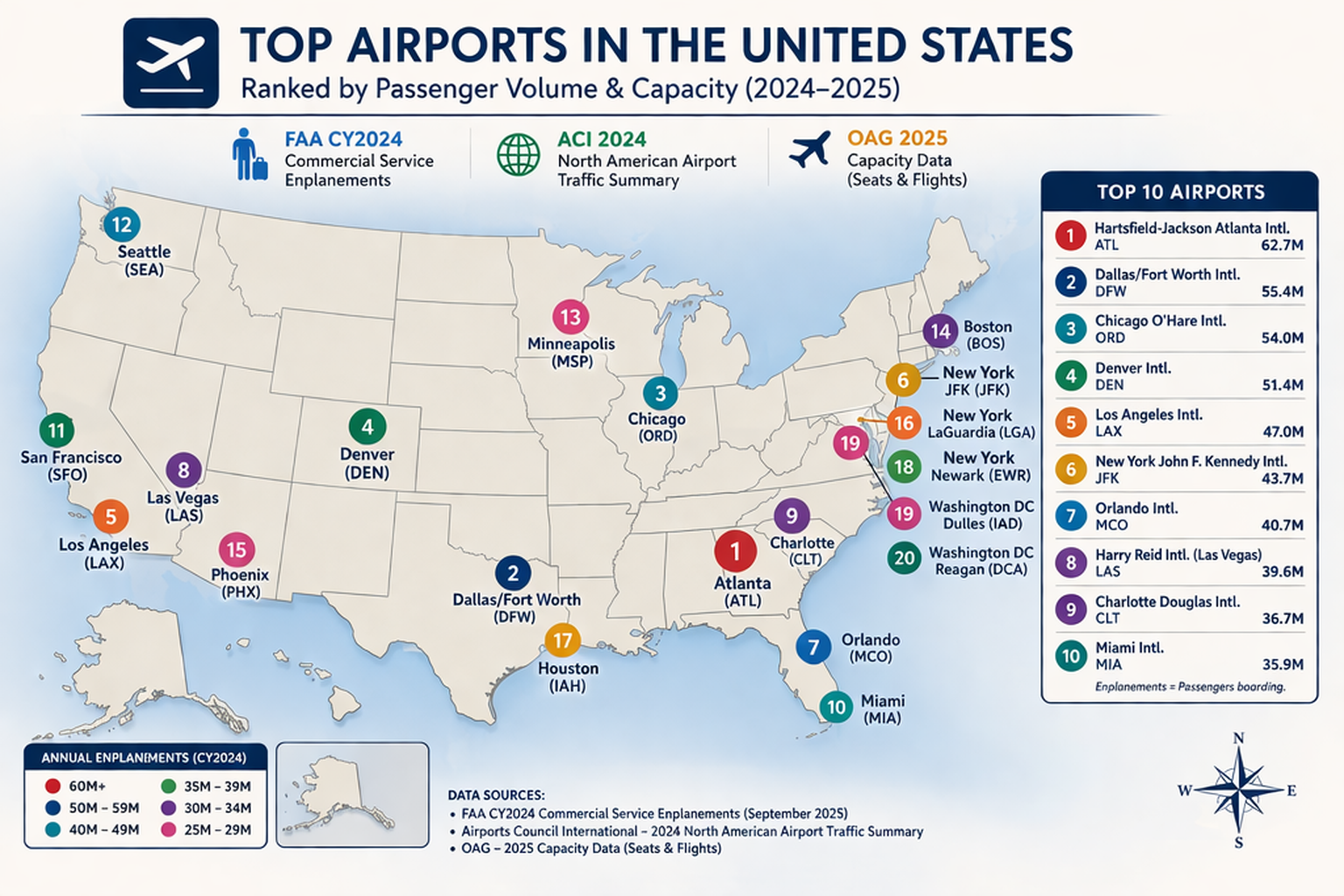
America’s airports are more than transit points — they’re economic engines, architectural landmarks, and the beating heart of a nation that moves over 900 million passengers a year. Whether you’re a frequent flyer choosing your next connecting hub, a traveler curious about what makes certain airports thrive, or an aviation enthusiast tracking industry trends, this guide breaks down the 25 busiest airports in the country using the latest official data from the Federal Aviation Administration.
All passenger figures cited below are Calendar Year 2024 enplanements (boardings) published by the FAA in September 2025 — the most recent complete dataset available.
1. Hartsfield-Jackson Atlanta International Airport (ATL)
Location: Atlanta, Georgia CY 2024 Enplanements: 52,511,402 Year-over-Year Change: +3.06%
Atlanta has held the title of the world’s busiest airport by passenger traffic for virtually every year since 1998, and 2024 was no exception. As Delta Air Lines’ primary global hub, ATL connects more than 150 domestic destinations and dozens of international cities. Its geographic position in the southeastern United States makes it a natural transfer point for travelers crisscrossing the country. The airport processed over 108 million total passengers in 2024 according to Airports Council International, reinforcing its dominance. A recent rivalry with Chicago O’Hare — which surpassed Atlanta in aircraft operations during 2025 — has done nothing to dislodge ATL from the top of the passenger rankings.
2. Dallas-Fort Worth International Airport (DFW)
Location: Fort Worth, Texas CY 2024 Enplanements: 42,351,316 Year-over-Year Change: +7.91%
DFW posted one of the strongest growth rates among the top five, jumping nearly 8% over 2023. As American Airlines’ largest hub, the airport benefits from Texas’s booming population and economy. Covering roughly 27 square miles, it’s one of the largest airports by land area in the country. DFW’s central location allows efficient domestic connections, and American Airlines has continued to expand its route network from this base.
3. Denver International Airport (DEN)
Location: Denver, Colorado CY 2024 Enplanements: 40,012,895 Year-over-Year Change: +5.68%
Denver International sits at the geographic crossroads of the nation, making it a critical hub for United Airlines, Southwest Airlines, and Frontier Airlines. At over 52 square miles, DEN is the largest airport in the United States by land area — and one of the largest in the world. The airport has been investing heavily in terminal expansion and updated security infrastructure to handle its rapidly growing volume. Its “banked schedule” approach maximizes connection efficiency between East Coast and West Coast routes.
4. Chicago O’Hare International Airport (ORD)
Location: Chicago, Illinois CY 2024 Enplanements: 38,575,693 Year-over-Year Change: +7.62%
O’Hare is uniquely positioned as a dual hub for both United Airlines and American Airlines, giving it an unmatched diversity of destinations. In 2025, O’Hare surpassed Atlanta in total aircraft operations — logging over 857,000 takeoffs and landings — though Atlanta officials note that passenger volume, not flight count, is the standard measure of “busiest.” The ongoing O’Hare 21 terminal modernization project is one of the largest airport expansions in the country, designed to add gates, improve passenger flow, and prepare the facility for decades of future growth.
5. Los Angeles International Airport (LAX)
Location: Los Angeles, California CY 2024 Enplanements: 37,760,834 Year-over-Year Change: -7.80%
LAX was the only top-five airport to see a decline in 2024, dropping nearly 8% from the prior year. The decrease may reflect ongoing construction disruptions from the airport’s massive modernization program, including a new Automated People Mover transit system and consolidated rental car facility. Despite the dip, LAX remains the primary West Coast gateway for international travel, serving more than 80 airlines and connecting to destinations across Asia, Europe, Latin America, and the Pacific.
6. John F. Kennedy International Airport (JFK)
Location: New York, New York CY 2024 Enplanements: 31,466,102 Year-over-Year Change: +2.15%
JFK is America’s premier international gateway, hosting more than 90 airlines and serving as a critical transatlantic hub. The airport’s ongoing New Terminal One project — a $9.5 billion development replacing aging terminals — aims to create one of the world’s largest international terminal complexes. JFK handles a disproportionate share of premium and long-haul traffic compared to other U.S. airports.
7. Charlotte Douglas International Airport (CLT)
Location: Charlotte, North Carolina CY 2024 Enplanements: 28,523,822 Year-over-Year Change: +10.15%
Charlotte posted the highest growth rate among the top 10, surging more than 10% year-over-year. As American Airlines’ second-largest hub, CLT benefits from its role as a connecting point between the Northeast and the Southeast. The airport has been quietly climbing the rankings for years, and its double-digit growth suggests it’s becoming an increasingly important node in the national air network.
8. Harry Reid International Airport (LAS)
Location: Las Vegas, Nevada CY 2024 Enplanements: 28,244,966 Year-over-Year Change: +1.25%
Las Vegas remains one of the country’s most popular leisure destinations, and its airport traffic reflects that. Unlike most airports on this list, LAS is not a traditional airline hub — its volume is driven almost entirely by origin-and-destination traffic. The city’s convention business, entertainment industry, and growing sports scene (home to NFL, NHL, and WNBA franchises) keep demand consistently high.
9. Orlando International Airport (MCO)
Location: Orlando, Florida CY 2024 Enplanements: 27,859,783 Year-over-Year Change: -0.62%
Orlando saw a slight dip in 2024 after several years of strong growth. The airport is the gateway to Walt Disney World, Universal Studios, and a constellation of other theme parks that make Central Florida one of the world’s top tourist destinations. MCO’s new Terminal C, which opened in 2022, has added significant capacity and modernized the passenger experience.
10. Miami International Airport (MIA)
Location: Miami, Florida CY 2024 Enplanements: 26,588,002 Year-over-Year Change: +7.57%
Miami is the leading U.S. airport for connections to Latin America and the Caribbean, and its 7.6% growth rate reflects booming demand on those routes. American Airlines operates its largest international hub here. MIA also ranks among the top cargo airports in the country, handling a massive volume of perishable goods, pharmaceuticals, and other high-value freight from Central and South America.
11. Phoenix Sky Harbor International Airport (PHX)
Location: Phoenix, Arizona CY 2024 Enplanements: 25,595,723 Year-over-Year Change: +7.18%
Phoenix’s growth mirrors the rapid population expansion across the Sun Belt. American Airlines and Southwest Airlines both maintain significant operations here. PHX benefits from being a year-round warm-weather destination and a gateway to the broader Southwest region.
12. Seattle-Tacoma International Airport (SEA)
Location: Seattle, Washington CY 2024 Enplanements: 25,414,592 Year-over-Year Change: +3.34%
Sea-Tac serves as the primary hub for Alaska Airlines and a major focus city for Delta Air Lines. The airport is a critical connection point for travel between the U.S. mainland and Alaska, Hawaii, and the Pacific Rim. Seattle’s thriving tech economy — home to Amazon, Microsoft, and Boeing — drives substantial business travel demand.
13. San Francisco International Airport (SFO)
Location: San Francisco, California CY 2024 Enplanements: 25,078,968 Year-over-Year Change: +3.67%
SFO is United Airlines’ Pacific gateway and one of the most important airports for trans-Pacific travel. The airport is also known for its extensive art collection, on-site museum, and sustainability initiatives. SFO has been recovering steadily from the pandemic’s impact on both business travel and the Bay Area tech sector.
14. Newark Liberty International Airport (EWR)
Location: Newark, New Jersey CY 2024 Enplanements: 24,544,320 Year-over-Year Change: -0.13%
Newark serves as United Airlines’ primary East Coast hub and is one of three major airports serving the New York metropolitan area. EWR handles a significant volume of international traffic, particularly to Europe and Latin America. The airport’s Terminal A replacement, which opened in 2023, has been a major upgrade for passengers.
15. George Bush Intercontinental Airport (IAH)
Location: Houston, Texas CY 2024 Enplanements: 23,349,157 Year-over-Year Change: +5.04%
Houston’s primary airport is United Airlines’ southern hub and a major gateway to Latin America and the energy industry’s global network. IAH’s international terminal handles routes to destinations across Mexico, Central America, South America, and beyond. Houston’s role as the energy capital of the world drives consistent business travel demand.
16. Boston Logan International Airport (BOS)
Location: Boston, Massachusetts CY 2024 Enplanements: 21,090,721 Year-over-Year Change: +5.65%
Logan is New England’s largest airport and a critical connection point for transatlantic travel, with direct service to dozens of European cities. The airport is served by JetBlue, Delta, American, and United, among others. Boston’s concentration of universities, hospitals, biotech firms, and financial institutions generates strong year-round demand.
17. Minneapolis-Saint Paul International Airport (MSP)
Location: Minneapolis, Minnesota CY 2024 Enplanements: 18,054,481 Year-over-Year Change: +6.08%
MSP is Delta Air Lines’ second-largest hub and has been consistently ranked among the best airports in the country by traveler surveys. Its central location makes it an efficient connecting point for flights between the coasts, and Delta has invested heavily in the facility. The airport is known for its clean terminals, efficient layout, and strong dining and retail options.
18. Fort Lauderdale-Hollywood International Airport (FLL)
Location: Fort Lauderdale, Florida CY 2024 Enplanements: 17,096,131 Year-over-Year Change: +0.19%
Fort Lauderdale serves as a budget-friendly alternative to Miami for South Florida travelers. Spirit Airlines and JetBlue both have significant presences here. The airport also benefits from its proximity to Port Everglades, one of the world’s busiest cruise ports.
19. LaGuardia Airport (LGA)
Location: New York, New York CY 2024 Enplanements: 16,715,567 Year-over-Year Change: +3.35%
LaGuardia has undergone a stunning transformation in recent years, with an $8 billion redevelopment replacing virtually the entire airport. Once notorious for its dated facilities, LGA now features modern terminals that rank among the best in the country. The airport primarily handles domestic flights and short-haul routes to Canada and the Caribbean.
20. Detroit Metropolitan Wayne County Airport (DTW)
Location: Detroit, Michigan CY 2024 Enplanements: 16,110,696 Year-over-Year Change: +4.76%
Detroit Metro is Delta Air Lines’ third-largest hub, with a particular focus on connecting flights between the Midwest and international destinations. The McNamara Terminal, Delta’s home base at DTW, is one of the largest single-airline terminals in the world and features an iconic lighted tunnel between concourses.
21. Philadelphia International Airport (PHL)
Location: Philadelphia, Pennsylvania CY 2024 Enplanements: 15,102,261 Year-over-Year Change: +10.57%
Philadelphia posted the strongest growth rate among the top 25, surging more than 10.5% year-over-year. American Airlines operates a significant hub here, with particular strength in transatlantic routes. PHL’s growth may reflect capacity additions and expanding service to European and Caribbean destinations.
22. Salt Lake City International Airport (SLC)
Location: Salt Lake City, Utah CY 2024 Enplanements: 13,543,570 Year-over-Year Change: +4.95%
Salt Lake City opened a brand-new airport in 2020, making it one of the most modern facilities in the country. Delta Air Lines operates a major hub here, and the airport serves as a gateway to Utah’s world-class ski resorts and national parks. The new terminal was designed with future expansion in mind and has been widely praised for its design and efficiency.
23. Baltimore/Washington International Thurgood Marshall Airport (BWI)
Location: Glen Burnie, Maryland CY 2024 Enplanements: 13,221,461 Year-over-Year Change: +2.89%
BWI is Southwest Airlines’ largest East Coast operation and serves the Baltimore-Washington metropolitan corridor. The airport competes with Reagan National and Dulles for passengers in the D.C. area, often winning on price thanks to its strong low-cost carrier presence.
24. Washington Dulles International Airport (IAD)
Location: Dulles, Virginia CY 2024 Enplanements: 13,003,234 Year-over-Year Change: +7.70%
Dulles is United Airlines’ Washington-area hub and the region’s primary airport for long-haul international flights. The opening of the Silver Line Metro extension has dramatically improved ground access to the airport, which had long been criticized for its distance from downtown D.C. Dulles grew nearly 8% in 2024, suggesting the improved transit connection is paying dividends.
25. San Diego International Airport (SAN)
Location: San Diego, California CY 2024 Enplanements: 12,780,013 Year-over-Year Change: +4.84%
San Diego rounds out the top 25 with steady growth fueled by tourism, a large military presence, and a growing biotech and tech sector. The airport’s single-runway configuration is famously constrained — it’s the busiest single-runway commercial airport in the country — and a new Terminal 1 replacement project is underway to modernize the facility and add capacity.
Key Trends Shaping U.S. Aviation in 2026
The Sun Belt continues to surge. Airports in Texas, Florida, Arizona, and the Southeast posted some of the strongest growth rates, reflecting population migration and economic expansion in warmer states.
Hub competition is intensifying. Charlotte’s 10% growth and Philadelphia’s 10.5% growth show that second-tier hubs are gaining ground, as airlines redistribute capacity beyond the traditional mega-hubs.
International travel is booming. Miami, JFK, and Dulles all saw strong growth driven by international demand, particularly to Latin America and Europe. International passenger traffic grew 8.7% industry-wide in 2024.
Infrastructure investment is massive. Nearly every airport on this list has a major construction or modernization project underway, from O’Hare’s terminal expansion to LAX’s transit system to JFK’s new Terminal One. The industry is spending tens of billions of dollars preparing for continued demand growth.
The Atlanta vs. O’Hare rivalry has a new chapter. Chicago claimed the title of busiest airport by aircraft operations in 2025, but Atlanta fired back by noting that passenger volume — the global standard — still belongs to Hartsfield-Jackson by a wide margin.
Methodology
Rankings are based on Calendar Year 2024 passenger enplanements (boardings) as reported by the Federal Aviation Administration in its CY2024 ACAIS dataset, published September 15, 2025. Enplanements count the number of passengers boarding aircraft at each airport and are the standard metric used by the FAA to categorize and fund airports. Total passenger figures (counting both arrivals and departures) would be roughly double the enplanement numbers shown. Additional context was drawn from Airports Council International, OAG, and the Bureau of Transportation Statistics.
Data sources: FAA CY2024 Commercial Service Enplanements (September 2025), Airports Council International 2024 North American Airport Traffic Summary, OAG 2025 capacity data.