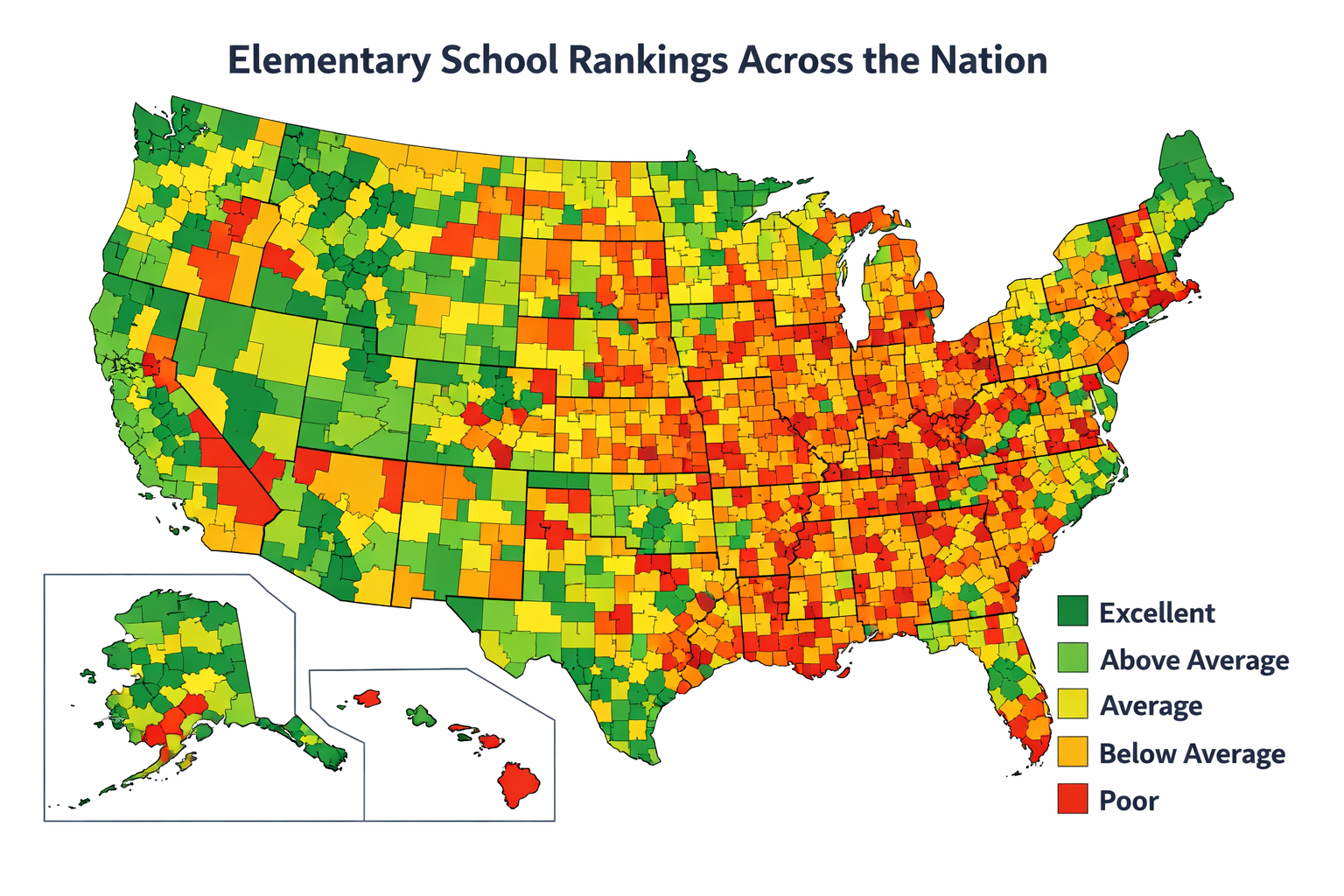
A parent’s guide to understanding the major ranking systems, what they measure, and what they miss.
Every October, millions of American parents do the same thing: they search for their child’s school in the latest national rankings. Whether they’re evaluating a potential move, choosing between districts, or simply curious how their neighborhood school stacks up, elementary school rankings have become one of the most consulted — and most debated — tools in American education.
But how exactly are nearly 50,000 elementary schools across 50 states evaluated, compared, and sorted into ranked lists? The answer depends on who’s doing the ranking. The two most prominent organizations — U.S. News & World Report and Niche — take meaningfully different approaches, and understanding those differences matters if you’re a parent trying to make sense of the results.
| # | School Name | City | State | Grades | Niche Grade | Students | S/T* Ratio |
|---|
The Scale of the Undertaking
The numbers alone are staggering. In its 2026 edition, U.S. News ranked approximately 47,000 public elementary schools and over 23,000 middle schools across the country. Niche’s 2026 release covers more than 93,000 public schools and 30,000 private schools. Together, these two platforms have assigned ratings or rankings to the vast majority of K-12 institutions in the United States, drawing from federal datasets maintained by the U.S. Department of Education, the National Center for Education Statistics, and — in Niche’s case — millions of reviews submitted by students, parents, and teachers.
The elementary and middle school rankings are a relatively recent addition to the landscape. U.S. News first ranked K-8 schools in October 2021. Before that, the conversation around school rankings focused almost entirely on high schools and colleges. The expansion to younger grades reflected growing demand from families who wanted the same kind of data-driven evaluation for the schools their children attend during the most formative years of their education.
U.S. News & World Report: Test Scores and Equity
U.S. News takes a deliberately narrow, data-driven approach to ranking elementary schools. Its methodology relies entirely on publicly available data from the U.S. Department of Education, and it evaluates schools on just two subject areas: mathematics and reading/language arts. The formula breaks down into four equally weighted components, each accounting for 25% of a school’s overall score:
Math Proficiency (25%) — The percentage of students who scored at or above the proficient level on their state’s math assessment.
Math Performance (25%) — The same math proficiency data, but adjusted through a regression model that accounts for the school’s socioeconomic demographics, including the percentage of students receiving free or reduced-price lunch and the percentage from historically underserved racial and ethnic groups.
Reading Proficiency (25%) — The percentage of students at or above proficient on the state reading/language arts exam.
Reading Performance (25%) — Reading proficiency adjusted for socioeconomic context, using the same regression model as math.
The split is significant. Half the formula rewards raw achievement — schools where a high proportion of students are meeting grade-level standards. The other half rewards schools that are outperforming expectations given their student population. A school in a low-income area where 70% of students are proficient in reading may rank higher than a school in an affluent suburb where 75% are proficient, because the first school is exceeding what the model predicts based on its demographics.
Student-teacher ratios are used only as a tiebreaker when two schools receive identical overall scores.
One critical detail: U.S. News does not produce a national ranking for elementary schools. Because every state administers its own assessments with different standards, cut scores, and difficulty levels, comparing a top-ranked school in Massachusetts against a top-ranked school in Mississippi is not statistically valid. Instead, schools are ranked at the state and district levels only. Charter schools receive their own separate state-level rankings.
Schools that fall below the 25th percentile have their exact rank concealed — they’re grouped together and shown as a range rather than a specific number. Schools serving special subgroups, those with fewer than 20 enrolled students, or those with fewer than 30 test-takers are excluded from the rankings entirely. All private schools are unranked, since they don’t participate in state assessments.
Niche: A Broader, More Subjective Lens
Niche takes a fundamentally different approach. Where U.S. News is narrow and test-focused, Niche attempts to capture a more holistic picture of what a school is actually like. Its Best Public Elementary Schools ranking incorporates academic data from the Department of Education alongside millions of reviews from students, parents, and teachers — more user-submitted school reviews, Niche claims, than any other platform on the internet.
The ranking factors for Niche’s elementary school evaluations include:
State Test Scores — Proficiency rates on state math and reading assessments, similar to U.S. News.
Student-Teacher Ratio — A measure of how much individual attention students may receive.
Student Diversity — The demographic composition of the student body.
Teacher Quality — Ratings and data related to the teaching staff.
Grade School Ratings — Aggregated survey data and parent/student reviews of the elementary experience.
District Quality — The overall performance and reputation of the school district the school belongs to.
Niche processes each of these factors into a standardized z-score — a statistical measure of how far each school falls from the average — then applies weighted multipliers determined by a combination of statistical analysis and user preference research. The resulting composite score is standardized again to produce a final ranking. Schools are also assigned letter grades from A+ down to D- (Niche intentionally does not assign anything lower than D-).
Unlike U.S. News, Niche does produce a national ranking for elementary schools. Its 2026 list named Pine View School in Osprey, Florida — a public school for gifted students serving grades 2 through 12 — as the #1 Best Public Elementary School in America. Niche also ranks schools at the state, metro, and district levels, and maintains separate rankings for categories like charter schools, magnet schools, STEM schools, and schools with the best teachers.
GreatSchools, SchoolDigger, and Other Sources
Beyond the two dominant platforms, several other organizations rate elementary schools. GreatSchools, which until recently was the default school rating embedded in Zillow and Realtor.com listings, assigns schools a 1-10 Summary Rating based on test scores, academic progress, equity, and college readiness (for older grades). GreatSchools places particular emphasis on growth — how much students improve over time — rather than just proficiency snapshots.
SchoolDigger ranks schools within each state based purely on state test performance, providing a simpler but more transparent methodology. The National Blue Ribbon Schools Program, run by the U.S. Department of Education, recognizes approximately 350 schools annually based on nominations and performance criteria, though it functions more as an award than a ranking system.
State education departments also publish their own school report cards, which typically include more granular data than any national ranking — attendance rates, chronic absenteeism, suspension data, teacher retention, per-pupil spending, and sometimes student growth metrics. These state-level reports often paint a more nuanced picture than a single rank number can convey.
What Rankings Measure Well
Rankings are effective at identifying schools with consistently strong academic performance in core subjects. They surface patterns that might be invisible to individual families — like a school in a modest neighborhood that’s dramatically outperforming similar schools — and they create accountability pressure that can push underperforming schools toward improvement.
For families relocating across state lines, rankings provide a starting point for evaluating schools they’ve never heard of. The aggregation of large federal datasets into a single, comparable format is genuinely useful for narrowing down options in an unfamiliar area.
The equity-adjusted components in both U.S. News and GreatSchools methodologies also highlight an important reality: some schools are achieving remarkable results with student populations that face significant socioeconomic challenges. Those schools deserve recognition, and rankings that adjust for demographics help surface them.
What Rankings Miss
The limitations, however, are substantial.
School culture and climate — whether students feel safe, supported, and engaged — don’t appear in any formula. A school with middling test scores but an extraordinary arts program, a deeply supportive counseling staff, or a strong anti-bullying culture won’t be rewarded in the rankings.
Student growth is largely absent from the major elementary school rankings. A school that takes students from far below grade level to nearly proficient has accomplished something extraordinary, but if those students still fall short of the proficiency cutoff, the school’s ranking suffers. U.S. News measures proficiency, not progress.
State-to-state comparisons are unreliable. Each state writes its own tests, sets its own proficiency thresholds, and defines grade-level standards differently. A school ranked #1 in a state with low proficiency standards may not outperform a school ranked #50 in a state with rigorous expectations. U.S. News addresses this by avoiding national rankings altogether; Niche attempts a national list but acknowledges the inherent imprecision.
Socioeconomic sorting is baked in. Despite equity adjustments, schools in affluent districts with highly educated parent populations consistently dominate the top of rankings lists. Test scores correlate heavily with household income, parental education, and housing stability — factors entirely outside a school’s control. Rankings risk reinforcing the perception that wealthy-district schools are inherently “better” rather than better-resourced.
Special programs and non-academic strengths are invisible. A school with an award-winning music program, exceptional special education services, a beloved community garden, or unusually strong parent involvement gets no ranking credit for any of it.
How to Use Rankings Wisely
Education researchers and school leaders consistently offer the same advice: use rankings as a starting point, not a verdict. A school’s rank is one data point among many. Visiting the school, talking to current parents, reviewing the state report card, and evaluating whether the school’s values and programs align with your child’s needs will tell you far more than a number.
As Kiran Bhai, director of K-12 and parenting programs at Harvard University’s Making Caring Common project, noted when the latest U.S. News rankings were released: choosing a school is a deeply personal decision that should account for a child’s individual strengths, personality, and needs. Every family is different, and the factors that matter most will look different for everyone.
Rankings tell you where test scores are high. They don’t tell you where your child will thrive.
Whether you’re moving or looking for your child’s next school, a comprehensive neighborhood intelligence report from GoodNeighborUSA can get you the information you need to make the best decision for your family.
Sources: U.S. News & World Report 2026 Best Elementary Schools Rankings; Niche.com 2026 Best Public Elementary Schools Methodology; edCircuit 2026 U.S. News School Rankings analysis; ConsumerAffairs 2026 Best States for Public Education.